

The cost of a med spa website is not just the number beside "design and development." Compare the launch fee, the exact pages and copy included, booking and CRM connections, migration work, recurring charges and what you can take with you if you leave. A low monthly price and a large one-time quote may cover very different jobs.
There is no defensible single price for every medical spa. One published vendor example gives a sense of the difference between a custom project and a software subscription: WTM Studio advertises med-spa website projects at $6,000 to $30,000, checked November 12, 2026. That is the vendor's own advertised scope and range, not a market average, an independently verified transaction price or a Fyntrix offer. The same page says ongoing SEO depends on scope rather than being automatically included.
Use the worksheet below to request comparable quotes for your actual practice. You should finish with a launch budget, a three-year ownership estimate and a written list of exclusions, not a vague promise of a "high-converting website."
Decide what you are buying before comparing prices
A clinic opening its first location needs different work from an established med spa migrating years of treatment content and search traffic. Write down the business problem first: an unclear treatment menu, a dated mobile experience, booking that stops at a generic contact form, or several real branches sharing confusing information.
Then choose the smallest useful scope that addresses it. Replacing a functioning website is not automatically the right response to low inquiries. If the problem is a broken booking connection, ask for that repair separately. If patients cannot tell which treatments you provide, the brief needs content and information architecture, not just a new color palette.
For a one-location practice, a starting brief might include a homepage, the actual treatment pages, a provider section, office information, a contact route and required policy pages. That is an illustrative scope, not a universal page count. List the treatments and named page types so a quote for five generic pages is not compared as though it included a complete treatment library.
For multiple genuine clinics, specify which services, providers, hours and booking routes differ by branch. Do not buy a package of interchangeable city pages that suggests offices you do not operate. A separate med-spa location-page guide explains that content task.
Compare three delivery models on the same scope
A website builder with internal work. You pay for the platform and any external setup help, while someone at the practice owns copy, images, page assembly, testing and maintenance. This may suit a small, straightforward site if that person has the time and skills. The subscription does not make their work free or establish that the booking and data flows are appropriate.
A subscription website service. A recurring charge may bundle hosting, design access, updates or marketing work. Ask about setup fees, minimum term, renewal price, revision limits and ownership after cancellation. A monthly service can be a sensible choice; the problem is treating its first month's fee as the full cost.
A fixed-scope custom project. A project fee can buy a defined discovery, design, copy and development process, with hosting and ongoing support priced separately. Ask what makes the work custom, who approves it and what changes cost. A higher fee is not evidence of better performance without a clear scope and acceptance tests.
None is the automatic winner. Compare the same treatments, locations, integrations, content responsibilities and exit conditions. Otherwise you are comparing a platform seat, a managed service and a completed website as if they were interchangeable.
Identify the items that change a med-spa website quote
Treatment content. Does the supplier write original pages, edit supplied copy or only paste what you provide? Who verifies the actual service, limitations, qualifications and assessment process? A template page with the treatment name swapped is not the same deliverable as a useful, reviewed explanation.
Brand and photography. Clarify whether the work includes identity changes, photography planning, image licensing and editing. Existing approved practice photographs may reduce production needs. Patient outcomes require a separate permission and accuracy process; do not assume a design fee includes suitable clinical evidence.
Booking and inquiry handling. Linking to an existing scheduler is different from configuring a connection that passes the intended service and location, updates records and handles failures. Specify the approved fields and systems. Ask who investigates a missing inquiry and whether integration support is included.
Migration. Existing articles, URLs, image files, forms and metadata need an inventory. Ask which content moves, which URLs change and who tests redirects. A redesign that launches beautifully while leaving old treatment links broken has not completed the migration job.
Locations and permissions. Multiple offices can require different staff access, approval rules and branch-specific content. Count the actual configuration and editorial work rather than assuming one additional location is only another address field.
Accessibility and performance. Ask for a described test scope across mobile and desktop, keyboard access, readable labels and feedback. The W3C forms guidance is a practical reference for labels, instructions and errors. A badge or an automated score alone does not define the whole acceptance process.
Ask what "SEO included" actually means
Have the supplier list the included tasks. For a rebuild, useful launch work may include a URL inventory, redirects to relevant replacements, editable page titles and descriptions, intended canonicals, crawlable navigation, an XML sitemap and post-launch checks. Ongoing research, writing, digital PR and reporting are separate activities unless specifically included.
Ask for an example deliverable rather than accepting "SEO optimized" as a line item. Will you receive a redirect map? Can you edit treatment titles without a developer? Who checks that the final live site is not accidentally noindexed? Is Search Console access held by the practice?
Google explains that a sitemap helps discovery but does not guarantee crawling or indexing. Do not pay for a guaranteed first-page ranking disguised as a technical setup fee. A completed sitemap and a ranking outcome are different things.
If your current site is not producing useful inquiries, review the med-spa SEO diagnostic before assuming a larger build budget is the answer.
Calculate a 36-month ownership cost
Use this formula for the same period and scope for every quote:
Total = setup and launch + recurring website charges + separately quoted work + expected exit or migration charges.
The following numbers are invented to demonstrate the arithmetic. They are not supplier quotes, Fyntrix prices, market benchmarks or a forecast of your costs.
- Example A, project model: $9,000 launch + $150 per month for hosting and support for 36 months + $1,200 of separately scoped work = $15,600.
- Example B, subscription model: $1,500 setup + $450 per month for 36 months + $1,200 of separately scoped work = $18,900.
Both calculations exclude taxes, advertising spend, booking-software subscriptions, payment fees and internal staff time. Neither establishes which option is better: the support, deliverables and exit rights may differ. If one quote includes writing twelve treatment pages and another includes none, normalize the scope before interpreting the totals.
Add the contractual renewal price, not just an introductory discount. Show any usage-based charges and minimum commitments separately. Ask what happens to the total if you add a branch, switch scheduling software or need more monthly changes. Do not turn a hypothetical contingency into a claim that you will definitely incur it.
Copy this quote-comparison worksheet
Download the editable website-quote comparison workbook. It calculates the ownership total for a shared comparison period and includes a scope checklist. The prefilled amounts reproduce the illustrative example above; they are not supplier quotes, Fyntrix prices or market averages. Replace them with comparable written quotes. Unknown amounts should remain blank until clarified, rather than silently becoming zero. No email address is required.
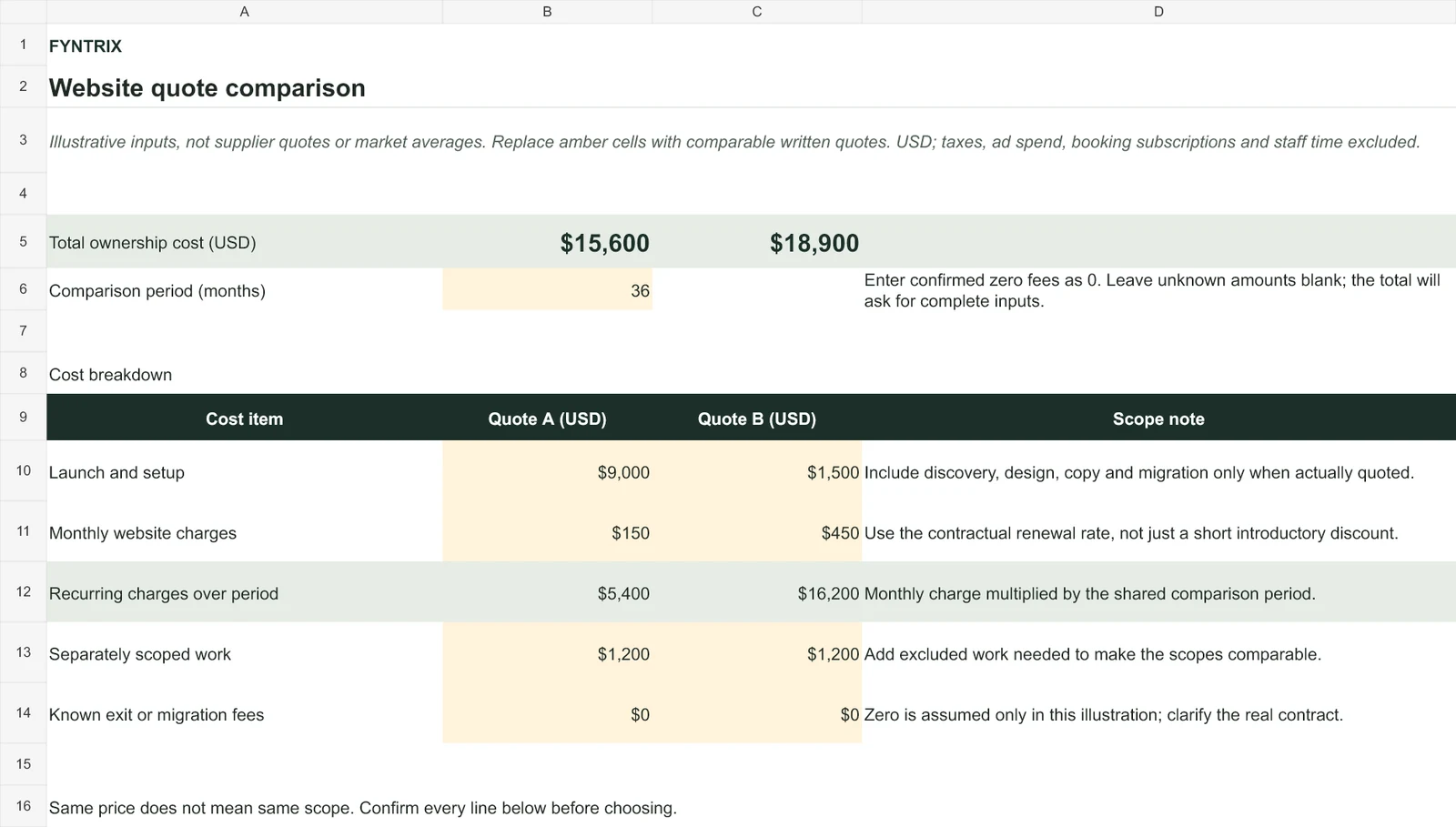
Screenshot of the downloadable Fyntrix worksheet with illustrative inputs. The article text explains the example independently of the image.
Create one column per supplier. For every row, record included, excluded or unclear, then add the fee and the contract reference where available.
- Page inventory: named treatments, provider pages, actual offices and policies.
- Copy: writer, number of pages, revision rounds and practice approval owner.
- Design: template or bespoke scope, responsive states and approved image production.
- Booking: existing platform, exact connection and behavior after a request.
- Forms and CRM: approved fields, receiving record, assigned owner, duplicate handling and alerts.
- Migration: content inventory, metadata, URL mapping and post-launch verification.
- Search foundations: sitemap, canonicals, indexability and Search Console ownership.
- Quality checks: mobile, keyboard, error states and performance test conditions.
- Recurring costs: hosting, maintenance, support limits, software seats and usage charges.
- Ownership: domain, content, design files, source or export rights, and account access.
- Exit: notice period, export format, transition assistance and stated fees.
- Acceptance: what must work before launch and who signs it off.
Leave unknowns visible. Do not replace an unanswered contract question with your best guess. Send the same clarification request to each supplier so the comparison is fair.
Send this brief when requesting a quote
"We operate [number] actual locations and offer [treatment list]. Our current website is [URL]. The main problem is [specific observed issue]. Please quote for the attached named page inventory, explain who supplies and approves copy and images, and describe how the website connects to [current booking and inquiry systems]."
"Please separate setup, launch, recurring support, third-party subscriptions, migration and optional marketing. Include change limits, account ownership, export rights, cancellation terms and a 36-month cost schedule using the current renewal terms. List anything excluded or dependent on our team."
Attach a short list of existing URLs that matter and the practical steps a visitor should be able to complete. Do not include patient records, photos or private conversations in a procurement brief.
This gives a supplier enough context to explain a scope. It does not require your receptionist to design the entire website before anyone can quote.
Agree on launch tests, not just an attractive homepage
Ask the developer and practice manager to walk through a labeled synthetic inquiry on a phone. Can a visitor find a real treatment, identify the appropriate location and request the stated next step? Does the receiving system contain one record with the right owner? Can staff act on it?
Test a booking-system failure and a form error as well as success. Confirm that the website does not say an appointment is booked when it has only collected a request. Sensitive intake should remain in a separately reviewed pathway rather than being added to a public marketing form for convenience.
Check the agreed old URLs, titles, canonical tags and sitemap after launch. Confirm that the practice controls its domain and has the agreed account access and export rights. Keep the handover record somewhere the next staff member can find it.
For a technical starting point, use the healthcare website SEO checklist. The business owner should receive the results and unresolved items, not merely be told that development is complete.
Questions owners ask about website pricing
Is a monthly website always cheaper? No. Compare the same scope over the contract period, including setup, renewal charges, excluded work and exit terms. Lower upfront cost may still be the right choice when it matches your cash-flow and support needs.
Should booking software be part of the website quote? The connection should be described. The software subscription may be separate. Ask which supplier owns configuration, support and failure handling rather than assuming both are covered.
Should treatment prices appear on the website? That is a separate content decision. Use the practice's actual approved pricing approach, inclusions and assessment requirements. Our guide to explaining med-spa treatment prices covers that task, not the cost of building the website.
Can a more expensive website guarantee more bookings? No. A clearer site can remove specific obstacles, but demand, positioning, traffic, available appointments and staff response still matter. Ask what the project will fix and how those changes will be checked.
If you want a scoped discussion of the work rather than a generic package, see Fyntrix's website and digital-experience service. The comparison worksheet above is usable independently, including when you choose another supplier.